The circumference is:
Table of Contents
Circumference, calculated instantly
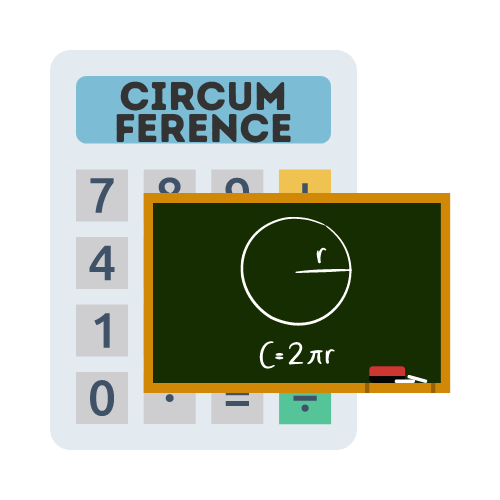
Enter a radius and this calculator returns the perimeter of the circle using C = 2πr. Use it for sizing rope around a pole, fencing a circular bed, wrapping cables, marking out arcs — anywhere you need the distance around a round shape.
The formula
The circumference of a circle is twice pi times the radius:
C = 2πr
- C — the circumference, in the same length unit as r.
- π — pi, the ratio of a circle’s circumference to its diameter, approximately 3.14159.
- r — the radius, the distance from the centre to the edge.
If you only know the diameter d, the formula simplifies to C = πd — that’s actually the original definition of pi.
Worked example
Using the default radius of 25 units:
- Double the radius: 2 × 25 = 50.
- Multiply by pi: π × 50 = 157.0796...
So C ≈ 157.08 units. If the radius were in centimetres, the circumference would be 157.08 cm; if in inches, 157.08 in.
Reference table
Circumference at standard radii, using π ≈ 3.14159:
| Radius | Diameter | Circumference (2πr) |
|---|---|---|
| 1 | 2 | 6.28 |
| 2 | 4 | 12.57 |
| 5 | 10 | 31.42 |
| 10 | 20 | 62.83 |
| 25 | 50 | 157.08 |
| 50 | 100 | 314.16 |
| 100 | 200 | 628.32 |
Doubling the radius doubles the circumference — unlike area, this scales linearly.
Related circle formulas
Radius, diameter, circumference and area are all linked:
- Diameter:
d = 2r - Circumference:
C = 2πr = πd - Area:
A = πr² - Radius from circumference:
r = C / (2π) - Circumference from area:
C = 2√(πA)
Arc length for an angle θ (in radians) is just a fraction of the full circumference: L = rθ.
Common applications
- Wheel travel. A bicycle wheel with a 35 cm radius covers about 220 cm per revolution — useful for cadence-to-speed calculations.
- Fencing & edging. The amount of edging needed for a round flower bed is the circumference — a 3 m diameter bed needs about 9.42 m of edging.
- Pipe wrapping. Insulation, tape and lagging are sold by length; the length you need to cover one full wrap equals the circumference plus a small overlap.
- Earth’s great circle. The Earth’s equatorial circumference is about 40,075 km. Eratosthenes calculated this to within 2% using shadows in the 3rd century BC.
Limitations & gotchas
- All inputs must share a single unit. Don’t mix metres with millimetres.
- The formula assumes a perfect circle. An ellipse’s perimeter has no closed-form expression — it requires Ramanujan’s approximation or an elliptic integral.
- π is irrational, so any displayed value is rounded. This calculator uses JavaScript’s
Math.PI(about 15 significant digits). - The radius must be positive.
Sources & references
- Weisstein, Eric W. “Circumference.” Wolfram MathWorld.
- Britannica, “pi (mathematics).” Encyclopaedia Britannica.
- Britannica, “Eratosthenes,” on the first known measurement of the Earth’s circumference.
FAQs
The circumference is C = 2πr, where r is the radius. Equivalently, C = πd when you know the diameter d. Both formulas describe the same length — the perimeter of the circle — using whichever measurement you already have.
Circumference is the perimeter of a circle specifically. The word ‘perimeter’ is the general term for the total distance around any closed shape; ‘circumference’ is reserved for round shapes — circles, ellipses, the Earth. The two words refer to the same idea but circumference is used when the shape has no corners.
Using 3.14 gives results that are accurate to about 0.05% — fine for school work and most DIY measurements. Using 3.14159 gets you to roughly one part in a million. NASA uses only 15 digits of pi to navigate spacecraft across the solar system, so longer expansions are rarely needed outside number theory.
Yes. If you know the area A, the circumference is C = 2√(πA). Derivation: A = πr² gives r = √(A/π); substituting into C = 2πr yields C = 2π × √(A/π) = 2√(πA).
Around 240 BC, Eratosthenes noticed that at noon on the summer solstice the Sun shone straight down a well in Syene (modern Aswan) but cast a 7.2° shadow in Alexandria, about 5,000 stadia north. Since 7.2° is 1/50 of a full circle, the Earth’s circumference must be 50 × 5,000 = 250,000 stadia — remarkably close to the modern figure of about 40,075 km.
The same length unit you used for the radius. A radius in metres gives circumference in metres; inches in, inches out. Make sure radius and any other dimensions share a unit before calculating — mixing centimetres and metres is the most common source of error.