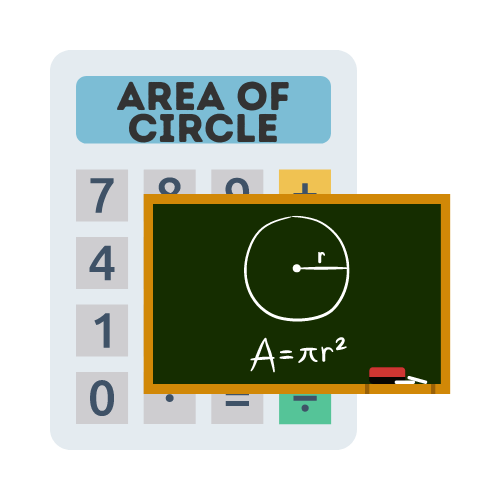
The circle area is:
Table of Contents
Area of a circle, calculated instantly
Enter a radius and this calculator returns the area using A = πr². Use it for sizing pizzas, pipes, gardens, dish antennas, irrigation coverage — anywhere you need the square footage inside a round shape.
The formula
The area of a circle is the product of pi and the square of its radius:
A = π r²
- A — the area, in square units (e.g. m², in²).
- π — pi, the ratio of a circle’s circumference to its diameter, approximately 3.14159.
- r — the radius, the distance from the centre to the edge.
If you only know the diameter d, halve it first: A = π(d/2)² = πd²/4.
Worked example
Using the default radius of 10 units:
- Square the radius: 10 × 10 = 100.
- Multiply by pi: π × 100 = 314.1592653...
So A ≈ 314.16 square units. If the radius were in centimetres, the area would be 314.16 cm²; if in inches, 314.16 in².
Reference table
Area of a circle at standard radii, using π ≈ 3.14159:
| Radius | Area (πr²) |
|---|---|
| 1 | 3.14 |
| 2 | 12.57 |
| 5 | 78.54 |
| 10 | 314.16 |
| 25 | 1,963.50 |
| 50 | 7,853.98 |
| 100 | 31,415.93 |
Notice how doubling the radius quadruples the area — that’s the square in πr² at work.
Related circle formulas
The radius, diameter, circumference and area of a circle are all linked:
- Diameter:
d = 2r - Circumference:
C = 2πr = πd - Area from circumference:
A = C² / (4π) - Radius from area:
r = √(A / π)
Sector and segment areas use the same constant: a sector of angle θ (radians) has area ½ r²θ.
Common applications
- Pizza sizing. A 16-inch pizza (radius 8″) has an area of about 201 in². A 10-inch pizza (radius 5″) has about 79 in². The 16″ gives you roughly 2.5× the food — not 1.6× as the diameter ratio implies.
- Pipe cross-section. Flow capacity scales with the cross-sectional area, so a 4-inch-diameter pipe carries about four times the flow of a 2-inch pipe at the same pressure.
- Irrigation coverage. A sprinkler with a 30-foot throw covers π × 30² ≈ 2,827 ft² per full rotation.
- Antennas and dishes. The gain of a parabolic satellite dish is proportional to the area of its aperture, so doubling the dish radius gives roughly four times the gain.
Limitations & gotchas
- All measurements must use the same unit. Don’t mix inches with centimetres.
- The formula assumes a perfect circle. Real-world shapes (an ellipse, an oval garden bed) need different formulas.
- π is irrational, so any displayed value is rounded. This calculator uses JavaScript’s full-precision
Math.PI(about 15 significant digits). - The radius must be positive — a circle of radius 0 has zero area.
Sources & references
- Weisstein, Eric W. “Circle.” Wolfram MathWorld.
- Britannica, “pi (mathematics).” Encyclopaedia Britannica.
- NASA/JPL Education, “How many decimals of pi do we really need?” (2022).
FAQs
The area of a circle is A = πr², where r is the radius. If you only know the diameter d, use A = π(d/2)² or equivalently A = πd²/4. Both formulas come from the same identity: a circle’s area equals pi times the square of half its widest measurement.
Pi is irrational because it cannot be written as a ratio of two integers — its decimal expansion goes on forever without repeating. This was proved by Johann Lambert in 1761. Pi is also transcendental, meaning it is not the root of any polynomial with rational coefficients, which is why you cannot ‘square the circle’ using only compass and straightedge.
Using 3.14 gives results that are accurate to about 0.05% — fine for school work, DIY projects and most engineering rough estimates. Using 3.14159 gets you to roughly one part in a million. NASA uses only 15 digits of pi to navigate spacecraft across the solar system, so longer expansions are rarely needed outside number theory.
Yes. If you know the circumference C, the area is A = C² / (4π). Derivation: C = 2πr, so r = C/(2π); substituting into A = πr² gives A = π × C² / (4π²) = C² / (4π).
A sector is a pie-slice of a circle. Its area is A = (θ / 360) × πr² when θ is measured in degrees, or A = ½ r²θ when θ is in radians. For a semicircle (θ = 180°), the area is half the full circle area.
Whatever length unit you used for the radius, squared. A radius in metres gives area in square metres (m²), a radius in inches gives area in square inches (in²). Make sure all measurements are in the same unit before plugging them into the formula — mixing centimetres and metres is the single most common source of error.